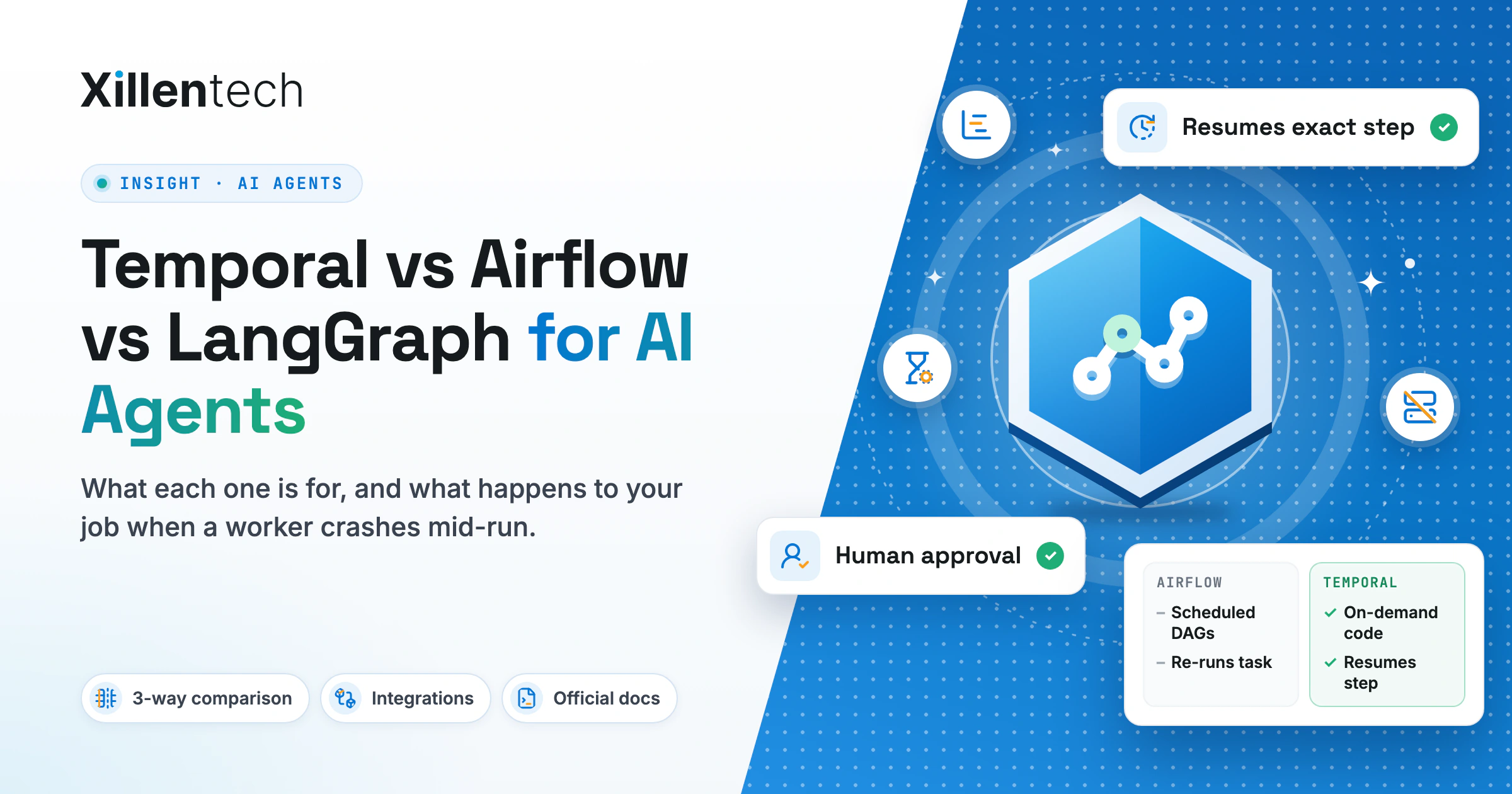

Temporal vs Airflow vs LangGraph: which should you use?
Use Airflow for scheduled batch data pipelines, LangGraph to define how an AI agent reasons and moves between steps, and Temporal when a job must survive crashes, long waits and human approvals without losing work. They solve different problems, and production AI systems often combine them: a LangGraph agent running inside a Temporal workflow, fed by Airflow pipelines.
The three get compared because each one "orchestrates" something. What they orchestrate, and what happens when a machine dies halfway through, is very different. This guide compares them on the questions that decide whether an AI agent holds up in production. Facts are from each project's official documentation, checked in November 2026.
What each one is
- Temporal is a durable execution platform. Its docs describe a workflow execution as "a durable, reliable, and scalable function execution" (Temporal docs). You write workflows as ordinary code, and side effects such as API calls, database queries and LLM calls go in activities.
- Apache Airflow is "a platform for orchestrating batch workflows" (Airflow docs), designed for workflows with a clear start and end that run on a schedule. Work is defined as tasks in a DAG.
- LangGraph is "a low-level orchestration framework and runtime for long-running, stateful agents" (LangGraph docs). You build an agent as a graph of state, nodes and edges.
What happens when a worker crashes mid-task
This is the difference that matters most for AI agents, because an agent that repeats completed steps after a crash repeats their cost and their side effects.
- Temporal keeps an event history, "a complete and durable log" of the workflow. After a failure a worker replays that history to recreate the state, and the workflow "picks up where the last recorded event occurred" (event history). Completed activities are not run again, and failed activities retry by default.
- Airflow works at the task level. A task whose worker dies is detected after the heartbeat timeout and marked failed, or retried from the start if retries remain (tasks). Since Airflow 3.3, a task can save its own key-value state that survives across retries and runs, so it can resume part-way if it is written to.
- LangGraph saves a checkpoint "at each super-step boundary", and on resume it doesn't re-run nodes that already succeeded (checkpointers). A node that was interrupted restarts from the beginning of that node. With LangGraph used as a library, your application has to notice the failure and invoke the graph again; the hosted LangSmith Agent Server resumes runs from the last checkpoint when a worker is interrupted.
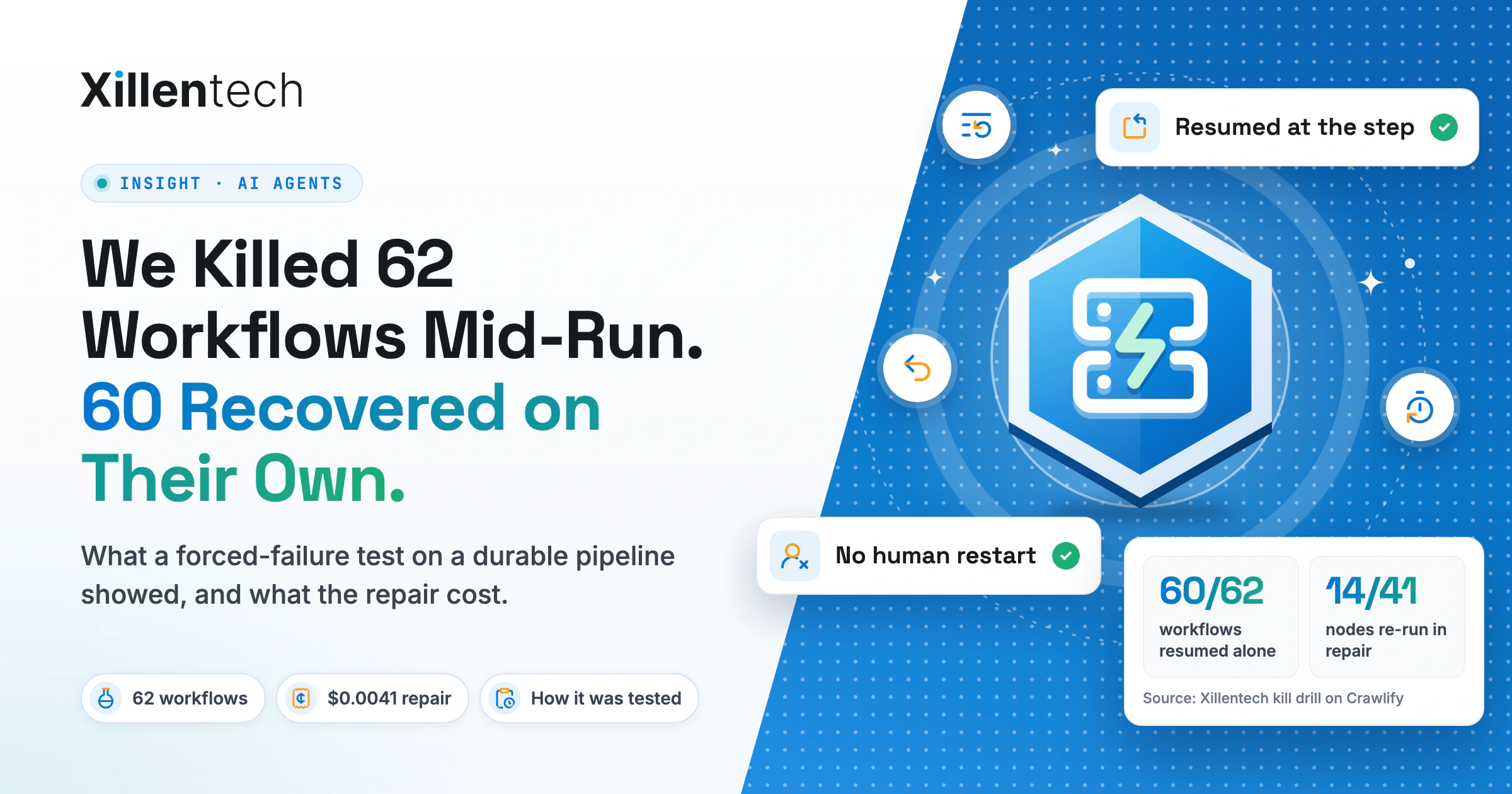
We tested Temporal's model on our own pipeline: when we killed the worker in 62 durable workflows mid-run, 60 resumed on their own.
Long waits and human approval
- Temporal timers are persisted, so a wait survives worker or service downtime and can last days or longer. A workflow can receive a human decision as a signal or update and continue from exactly where it paused.
- Airflow has deferrable operators: once deferred, "the task no longer occupies a worker slot" (deferring). A human-in-the-loop operator was added in version 3.1.
- LangGraph has
interrupt(): the graph pauses and "waits indefinitely until you resume" (interrupts), which needs a checkpointer and a thread ID.
All three can pause for a person. The question is whether the pause survives a restart without help. That is what makes human-in-the-loop approval gates safe to rely on.
Scheduling, languages and hosting
| Temporal | Airflow | LangGraph | |
| Started by | Your application, on demand; Schedules for timed runs | A schedule (cron, timetables, assets), or manually from the CLI, API or UI | Your application, as a library call; cron jobs on Agent Server |
| Code rules | Workflow code must be deterministic so it can be replayed; side effects go in activities | No replay rule; each task is a separate execution | No strict rule |
| Languages | Eight SDKs: .NET, Go, Java, PHP, Python, Ruby, Rust, TypeScript | Python; TypeScript, Java and Go DAGs added in 3.4 | Python and JavaScript/TypeScript |
| Hosting | Self-hosted, or Temporal Cloud (your workers stay in your environment) | Self-hosted, or managed services such as Amazon MWAA | Your own app, or LangSmith Agent Server |
| Licence | MIT | Apache Software Foundation project | MIT |
| Recovery unit | The exact step, by replay | The task, from its start | The node, from its start |
Using them together
The combinations are common enough that the projects now ship integrations:
- LangGraph inside Temporal. Temporal's LangGraph plugin runs a LangGraph graph as a Temporal workflow, with nodes able to run as activities and an
interrupt()resumed by a Temporal signal. In October 2026 Temporal announced general availability of integrations for several agent frameworks, including LangGraph, the OpenAI Agents SDK and Google ADK. - OpenAI Agents SDK inside Temporal. In this integration, model calls run as activities, "so they retry durably and are not repeated during Workflow replay" (Temporal docs).
- Agents inside Airflow. Airflow 3.4's Common AI provider adds an AgentOperator that runs a tool-using agent as a task, with an option to pause for a person to approve a tool call.
- Airflow alongside Temporal. There is no official joint integration. Teams that use both typically keep Airflow for scheduled data pipelines and Temporal for application workflows and agents.
How we choose
For the AI systems we build, the choice follows the failure that would hurt most:
- A nightly data pipeline that loads, cleans and publishes data on a schedule: Airflow is built for it.
- An agent's reasoning, meaning which tool to call next and how state moves between steps: LangGraph or a similar agent framework.
- Anything that must not lose work or repeat side effects, such as agents that write to records, wait days for an approval, or run long multi-step jobs: Temporal, often wrapping the agent framework.
If you are deciding whether your agents need durable execution, our Temporal consulting page covers when a retry and a queue are enough and when they aren't.
Frequently Asked Questions
What is the difference between Temporal and Airflow?
Airflow orchestrates scheduled batch workflows: DAGs of tasks with a clear start and end, usually data pipelines that run on a timetable. Temporal runs durable application workflows started on demand by your code, and it recovers a failed workflow at the exact step it stopped by replaying its event history. Airflow recovers at the task level, re-running a failed task from its start. Choose Airflow for data pipelines on a schedule, and Temporal for long-running jobs, agents and workflows that wait for people or external events.
What is the difference between LangGraph and Temporal?
LangGraph is an agent framework: it defines how an AI agent reasons, which nodes it moves through and what state it carries, and it checkpoints that state between steps. Temporal is a durable execution platform: it guarantees that a workflow survives crashes, restarts and long waits, resuming at the exact step it stopped. A LangGraph node that is interrupted restarts from the beginning of that node, and the application has to re-invoke the graph unless it runs on a hosted server. Many teams use LangGraph for the agent logic and Temporal underneath it.
Can LangGraph and Temporal be used together?
Yes. Temporal publishes a LangGraph plugin that runs a LangGraph graph as a Temporal workflow. Graph nodes can run as Temporal activities, so their results are recorded and not repeated after a crash, and a LangGraph interrupt can be resumed with a Temporal signal, which suits human approval steps. Temporal announced general availability of its agent framework integrations, LangGraph among them, in October 2026. The plugin is Python only and has some limits, for example Temporal's retry policy replaces LangGraph's.
Does Airflow support human-in-the-loop approval?
Yes, since version 3.1, which added a human-in-the-loop operator that pauses a task until a person responds. From version 3.3 a waiting task holds no worker slot while it waits. Airflow 3.4's Common AI provider also lets an agent task pause for a person to approve a tool call. These suit approvals inside scheduled data pipelines. For approvals inside long-running application workflows or AI agents, Temporal signals and LangGraph interrupts are the more common tools, because they live in the same code as the agent.
Do I need Temporal for AI agents?
Not always. A short agent that answers one request in a few seconds can usually rely on simple retries. Temporal earns its cost when an agent runs long multi-step jobs, writes to records or calls paid APIs that must not be repeated, waits hours or days for human approval, or must not lose work when a process dies. In those cases durable execution prevents repeated side effects and lost progress. The trade-off is learning Temporal's model, including keeping workflow code deterministic.