Strategy without software
A strategy engagement that produced a document and no working software.
AI that works. Even on its worst day.
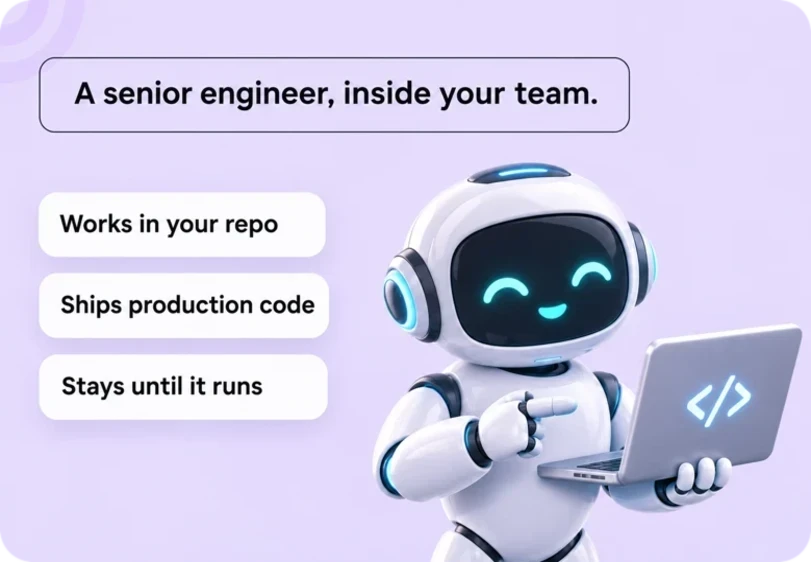
A forward deployed engineer is a senior engineer who works inside your team and your codebase, writes the production code, and stays until the system runs reliably. The model came from Palantir. We apply it to one thing: AI agents that work in a demo and fail under real traffic.

Xillentech engineered specialized Autonomous Agents including Voice Command AI to automate our workflows end-to-end. They transformed complex requirements into predictable, scalable outcomes.





Two things usually go wrong before a team calls us.
A strategy engagement that produced a document and no working software.

Contract engineers who shipped quickly and left behind a system nobody on your team can explain.
A forward deployed engineer writes the production code and documents it as they go — you get working software, and a team that understands it.
Palantir built the model in the early 2010s, putting engineers inside customer organizations rather than sending consultants from a separate project. Around 120 forward deployed engineers worked inside JPMorgan starting in 2009.
The AI labs have since copied it. OpenAI grew its forward deployed engineering team from 2 people to 39 in a single year, then formalized the approach in a joint venture that raised over four billion dollars. Anthropic announced its own enterprise deployment venture, valued at 1.5 billion dollars.
They copied it because deployment, not model quality, is where enterprise AI fails.
120
forward deployed engineers Palantir put inside JPMorgan, starting 2009
2 → 39
OpenAI's forward deployed engineering headcount, in a single year
$4B+
raised by OpenAI's deployment joint venture (Anthropic's own: $1.5B)
of AI pilots deliver no measurable P&L impact
MIT Media Lab's NANDA initiative studied 300 public AI deployments alongside 52 executive interviews and 153 survey responses. Ninety-five percent of the pilots delivered no measurable impact on profit or loss.
— MIT NANDA, “The GenAI Divide”

Your branch, your review process, your standups — not a parallel project handed over at the end.

The same person who scopes the work writes it.

Before fixing anything, we instrument the system so you can see what's breaking and how often.

Documentation, runbooks, and a working handover.
Three stages, the same Map, Build & Prove, Operate shape as the rest of our work — scoped to one engineer embedded in your team.
We read the code, run the system until it breaks, and write down every failure mode. You get the list whether or not you continue.
Retries that resume, approval gates on anything irreversible, evals built from your real failures gating every deploy.
Monitoring, on-call, and a monthly report — continuing as a retainer or transferring to your team.

We built Crawlify on Temporal and then broke it on purpose. The numbers below are what happened — the same evidence-over-credentials approach the strongest people in this category use, because "trust our engineers" means nothing until you've seen what they've actually shipped.


60 of 62
workflows recovered on their own when we forced them to fail

$0.0041
to re-run 14 of 41 nodes in a targeted repair, instead of re-running the whole job

1,600+
eval tests running against gold datasets
A senior engineer who works inside a client's team and codebase rather than from a separate agency project. They write the production code themselves, attend the client's standups, use the client's review process, and stay until the system runs reliably in production.
A consultant delivers a recommendation and is measured on the quality of that advice. A forward deployed engineer delivers running software and is measured on whether it works in production.
Yes, if what you need is a senior engineer who writes production code inside your team. It differs from staff augmentation in what the engineer is accountable for: not hours or tickets, but getting your AI system running reliably in production, then documenting it and handing it over so your own team can run it. If you only need extra hands to work through a backlog, a staffing firm is the better fit, and we will say so before any engagement starts. Teams that want to build the skills themselves can start with our AI training for engineering teams.
Most run between six and twelve weeks. Week one is diagnostic. Weeks two to six are the build. From week seven the work shifts to operating the system, which either continues as a monthly retainer or transfers to your team.
Yes, all of it. The code is written in your repository, in your branch, through your review process, so it's yours from the first commit.
We don't publish rates. We scope it in a working session first: you describe what the system does and where it breaks, and we come back with a fixed scope and a fixed fee before any work starts.
Three situations: you need something fast and disposable to show an investor, not production-grade; you want a fixed-price deliverable with no ongoing access to your own team; or you haven't decided to build with AI yet. In any of those cases, a reliability audit is the cheaper starting point. And if you'd rather have the agent built for you as a scoped project, see building an AI agent that survives production.
No pitch deck, no retainer commitment up front — just a working session about what your system does today and where it's likely to fail.
Tell us what the system does and where you think it will break. We'll scope the engagement in a working session — no commitment beyond that conversation.