
What is a kill drill?
A kill drill is a forced-failure test: you stop a running system without warning, the way a crash or a bad deploy would, and record what happens next. We ran one on Crawlify, the managed data-extraction pipeline we built on Temporal, to check whether durable execution holds up when a worker dies in the middle of a job.
Most AI agents and data pipelines are tested on the happy path: clean inputs, a healthy machine, someone watching. Production adds the failures nobody stages. A process that dies mid-job is one of the most common, and one of the most expensive, because a system that can't resume has to start again from zero. We wanted a number for how our own system behaves when that happens, measured rather than estimated.
What we did
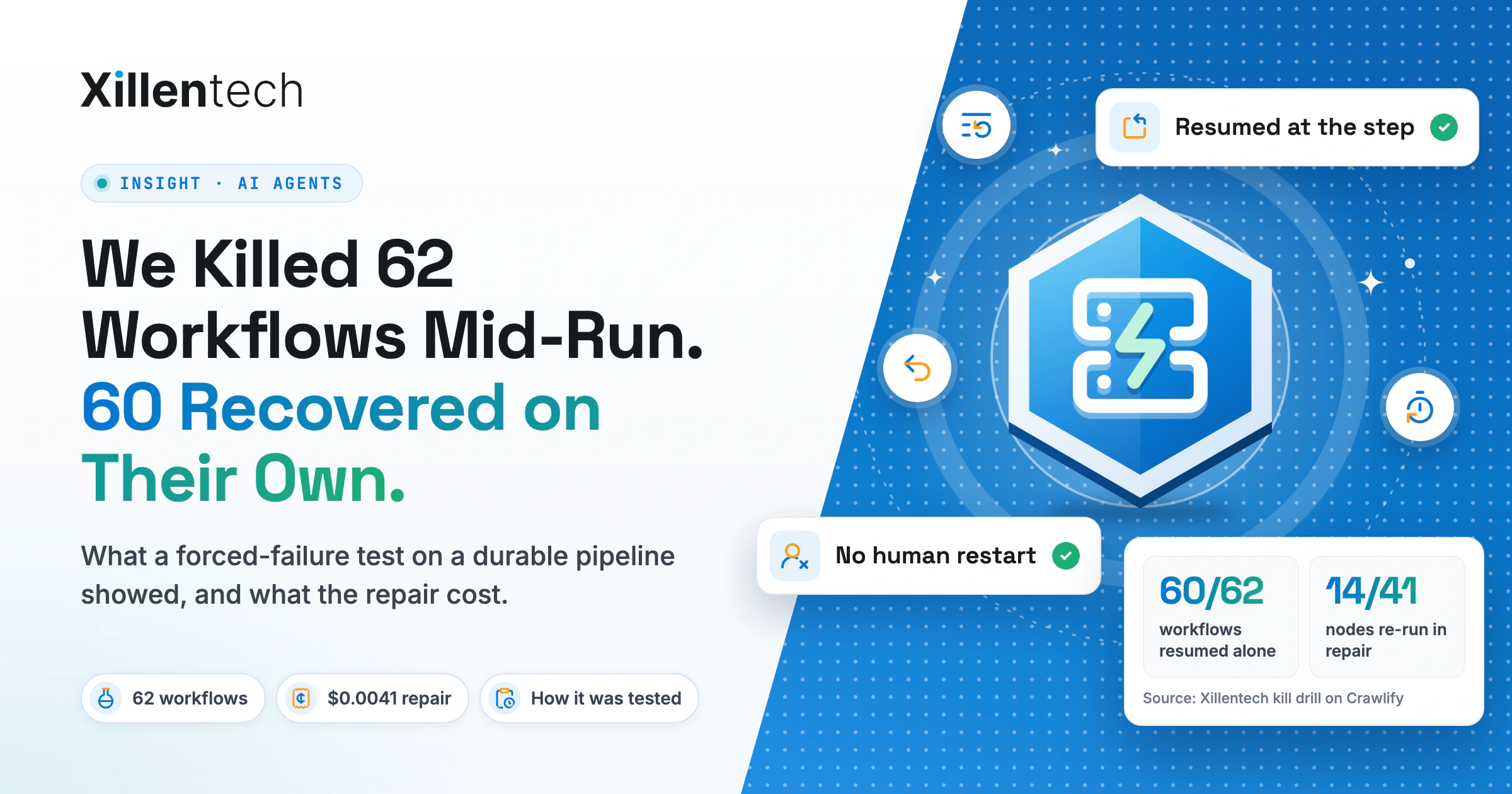
A child workflow is a self-contained unit of execution inside a larger Temporal workflow, with its own recovery boundary. We forced a failure in 62 child workflows: we killed the worker process mid-run, with no clean shutdown and no warning.
Nothing was prepared for the restart. No one stood by to re-run anything, and no step was marked as safe to repeat in advance. The only thing the system had to recover from was its own recorded history.
What “recovered” means
“Recovered” means something specific here. The workflow resumed from the exact step it was killed at, using Temporal's recorded event history, with no human restarting it, re-running finished steps, or touching it at all.
That definition matters because a looser one is easy to pass. A job that restarts from the beginning and eventually finishes has also “completed”, but it has repeated every step, every API call and every cost along the way. We only counted a workflow as recovered if it picked up where it stopped.
The result: 60 of 62, and a $0.0041 repair
Sixty of the 62 workflows resumed on their own.
The repair was targeted in the same way. In the job we measured, 14 of its 41 nodes re-ran, for $0.0041 in total. The other 27 had already finished, so their results were kept instead of being produced again. Re-running the full 41-node job from the start would have cost more, in both money and time, for an identical result.
The two that didn't recover
Two of the 62 workflows did not resume on their own. We haven't published a cause for those two yet, because we only publish one once it is verified and specific. A guessed explanation would undercut the 60 it sits next to, so the result is reported exactly as measured: 60 of 62.
What it costs to run
Per-source extraction with Crawlify runs $0.004–$0.12, against $2.40–$6 for a free-running AI agent doing the same job. The gap comes from the repair model above: a broken step costs fractions of a cent to fix, because only that step re-runs.
Why this matters for AI agents
A crash in the middle of a job is one of the five usual reasons AI agents fail in production. An agent that holds its progress only in memory loses it when the process dies, and the next run repeats tool calls that already succeeded, including the ones that cost money or changed a record.
Durable execution is what produced the 60 of 62 result. It is one of the parts covered in our guide on how to build an AI agent, and we build the same pattern into the agents we work on: production hardening for agents that already exist, and Temporal consulting for new builds and migrations. If you don't know how your own agent behaves when its worker dies, a reliability audit runs this kind of test on your system.
Frequently Asked Questions
What is a kill drill in software?
A kill drill is a forced-failure test. You stop a running system without warning, the way a crash, an out-of-memory error or a bad deploy would, and then record what the system does next: whether it resumes, restarts from zero, loses work or needs a person to step in. It measures recovery under a real failure instead of assuming it from the design. We ran ours by killing the worker process in 62 durable workflows mid-run, with no clean shutdown.
What is a child workflow in Temporal?
A child workflow is a self-contained unit of execution started by a larger parent workflow in Temporal. It has its own event history and its own recovery boundary, so a failure inside one child doesn't force the whole parent job to start again. In this test, each of the 62 child workflows was a separate unit we could kill and then watch: either it resumed from the step it was on, or it didn't. Splitting a long job into child workflows is also what keeps a repair small: only the broken unit re-runs.
What counts as “recovered” in this test?
A workflow counted as recovered only if it resumed from the exact step it was killed at, using Temporal's recorded event history, with no human restarting it, re-running finished steps or touching it at all. A job that restarted from the beginning and eventually finished would not count, because it would have repeated every completed step and its cost. Sixty of the 62 workflows met that definition. The strict version matters for cost: every repeated step is a repeated API call, and in an AI agent possibly a repeated action on a real record.
Why didn't two of the 62 workflows recover?
We don't know yet, and we haven't published a cause. We only publish an explanation once it is verified and specific, because a guessed one would undercut the 60 results it sits next to. The figure is reported exactly as measured: 60 of 62 workflows resumed on their own and 2 did not. When the cause is confirmed, this answer will say what it was and what we changed. Until then, read the result as 60 of 62, with the two failures still open.
How can I test whether my own AI agent survives a crash?
Run the same kind of test on a copy of your system. Start a real job, kill the process partway through without a clean shutdown, and check three things: whether the job resumes from the step it stopped at, whether any finished step or paid API call runs twice, and whether anyone had to intervene. If the agent restarts from zero or repeats actions, it needs durable execution. A reliability audit runs this test, and the other failure tests, for you in one to two weeks.