Who watches our AI agents once they're live?
We do, every month. We monitor every run, get paged when one fails, fix it, and send you what broke and what it cost. Most teams find out an agent has been failing when a customer tells them. This is the alternative.



Xillentech engineered specialized Autonomous Agents including Voice Command AI to automate our workflows end-to-end. They transformed complex requirements into predictable, scalable outcomes.




AgentOps is a discipline, not a tool
The AI equivalent of DevOps. Even the platforms named after the term agree it's bigger than any one tool — as one puts it, AgentOps is:
“the operational discipline of managing autonomous AI agents in production”

Buy a tool, run it yourself
Open-source SDKs and dashboards give you the data. You still watch it, triage it, and fix it.

Hire the retainer, we run it
We watch every agent, triage every failure, and ship the fix. You get a monthly report, not a dashboard to babysit.
What we watch
Five specific dimensions, every month — not a vague promise to "keep an eye on it."
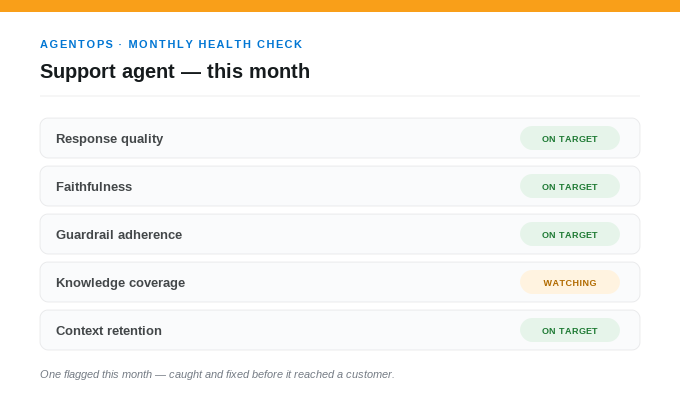

Response quality
Is the agent's output actually good, not just fluent.

Faithfulness
Is it telling the truth, grounded in your real data — not a confident guess.

Guardrail adherence
Is it staying inside the boundaries you set, every time, not just usually.

Knowledge coverage
Is it drawing on current, correct data, or something stale or missing.

Context retention
Does it remember what it should across a longer conversation or multi-step task.
Where this fits
This page is one stage of our Production Protocol — Map, Build, Prove, Operate. The first three happen before launch; this is what happens after.

Operate
Stay on to keep it reliable as models, traffic, and data change.
You are here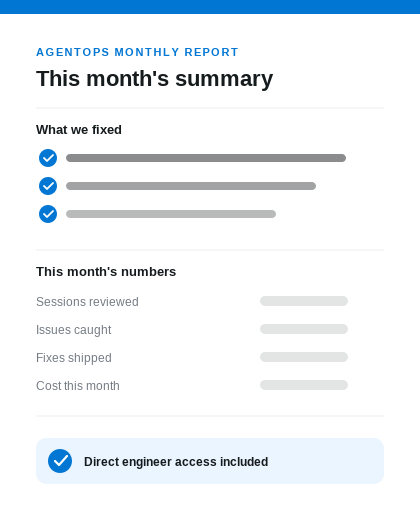
What's included
Six things in every retainer, not a dashboard login and a hope.

Continuous monitoring
Across every agent in scope, daily.

Monthly report
What broke, what it cost, what we changed.

Session replay
See exactly what the agent did on any failed run, not just that it failed.

Human-feedback integration
Real usage patterns feed back into what gets fixed and improved.
Direct engineer access
The person who did the work, not a support queue.

Fixes included
Shipped as part of the retainer, not billed separately.
What it actually costs to run an agent properly
Numbers from Crawlify, the data-extraction agent we built and operate ourselves — run through the same discipline this retainer sells.

$0.004–$0.12
per source, versus $2.40–$6 for a free-running agent

$0.0041
to re-run 14 of 41 nodes in a targeted repair instead of the whole job

How much does an AgentOps retainer cost per month?
It's sized to how many agents you run and how critical they are. We scope the monthly rate together, and you can start with one agent and add more later.
Frequently asked questions
AgentOps is the operational discipline of monitoring, maintaining, and improving AI agents after they're live in production — tracking whether they're still behaving correctly, what they cost to run, and fixing failures as they happen. It's often compared to DevOps: a set of practices, not a single tool.
Both exist. There are open-source SDKs that give you dashboards and logging you operate yourself. Xillentech's AgentOps Retainer is the service version — we do the monitoring, the triage, and the fixing, using our own tooling, and you get a monthly report instead of a dashboard to watch.
LLMOps covers running the language model itself: prompts, model versions, output evaluation and inference cost. AgentOps covers what an agent built on that model does across a whole workflow: multi-step runs, tool calls, approvals, retries and failures. An agent can sit on a well-managed model and still fail in production, because the failure is in the run, not the response. That is why an AgentOps retainer watches every run end to end, not just what the model returns, and reports what broke and what it cost each month.
Usually, nobody, until something breaks visibly enough for a customer to notice. An AgentOps retainer puts a team on continuous watch: daily canary tests against a known-good baseline, drift checks after every model provider update, and cost tracking on every run.
It depends on the severity agreed in scope. For anything customer-facing, we treat it like an incident: diagnose, fix, and report what happened. For lower-stakes internal tools, it gets fixed in the next working cycle.
When something goes wrong, session replay means we can reconstruct exactly what the agent did on that specific run — which tools it called, what data it read, what it decided and why — rather than just knowing that it failed.
Yes. Most retainers start narrow — the one agent that's actually customer-facing or actually costs money when it breaks — and expand once the value is obvious.
Let’s make it survive its worst day.
Monitoring catches what breaks. If you haven't hardened the agent yet, that's a conversation worth having first.
Ready to put your agents on continuous watch?
Tell us how many agents you run and what happens when one fails today. We'll scope the retainer in a working session — no commitment beyond that conversation.