Crashes mid-job
A worker that crashes halfway through a job, with no resume — and no one taught the team how to make it pick up where it left off.
AI that works. Even on its worst day.
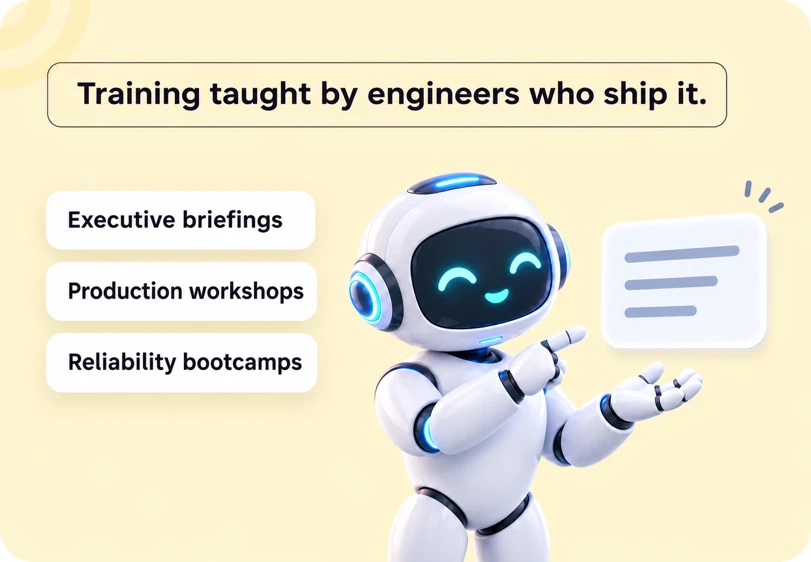
We run three programs: a half-day Executive AI Briefing for leadership, a one-to-two day Production AI Workshop for engineering teams, and a multi-week AI Reliability Bootcamp with office-hours follow-up. All three are taught by the engineers who built Crawlify, and all three teach what makes AI hold up in production.

Xillentech engineered specialized Autonomous Agents including Voice Command AI to automate our workflows end-to-end. They transformed complex requirements into predictable, scalable outcomes.




Most AI consultancies treat training as something that happens along the way: a workshop mentioned in a case study. Few offer it as a service you can book on its own. We built ours as a standalone program because the gap it closes is specific.
Teams learn to build an agent that works in a demo. Nobody teaches them what changes once it has to survive real traffic.
A worker that crashes halfway through a job, with no resume — and no one taught the team how to make it pick up where it left off.

A model update that quietly changes the agent's answers, with nothing in the pipeline built to catch it.

An action that can't be undone, taken without anyone approving it first — because no one taught the team to gate it.
That is the part we teach, because it is the part we are hired to fix.
Two audiences, with two different formats.

Whose team needs to stop shipping agents that break in production. They send engineers to the Production AI Workshop, or to the Reliability Bootcamp when the team is building agents right now.

Who need a plain-language briefing on what AI reliability actually requires before they fund or buy it. They book the Executive AI Briefing: no code, just what to ask a vendor and what to expect.
Each one stands on its own. The workshop is a complete engagement, and the bootcamp is there for teams that want support while they put it into practice.
What production AI reliability requires, in plain language, and the questions to ask a vendor before you sign.
Non-technical. No coding.
Hands-on: durable execution, eval-gated deployment, and approval-gate architecture, taught against your own codebase wherever possible.
Live, hands-on, on your code where the format allows.
The workshop's material applied to the agent your team is building, with office-hours access while the work is underway.
Ongoing, alongside your team's own work.
Three patterns, the same ones we use on client systems and on Crawlify, the agent system we run ourselves.

How to make a long-running agent job survive a crash: it resumes at the step that failed, instead of restarting from zero and repeating API calls that already cost money once.

How to build a test suite from your system's real failure cases, and block a deploy until it passes, including a routine model update that quietly changes the agent's answers.
How to make anything an agent does that can't be undone wait for a person to approve it, with a circuit breaker that stops the agent after repeated failures.
Three steps, whichever program you book.
Tell us your team and your goals. We match you to a program and, for the hands-on formats, arrange access to the codebase we'll teach against.
Live and hands-on wherever the format allows, against your actual codebase, taught by engineers who build and break production agents.
Bootcamp teams get office-hours support while what they learned becomes the way they work, written down in runbooks the team keeps.

Most AI training available today is self-paced. Coursera for Business says over 4,700 companies use it, with courses from partners such as DeepLearning.AI. Claude Academy runs self-paced courses of roughly 45 minutes to 4 hours, each with a quiz, including an AI Fluency series. LangChain Academy's free LangSmith Essentials course covers agent observability and evaluation. All of that builds useful general fluency.
Both are useful. They answer different questions: a course builds general fluency, and the workshop is about whether your team's next agent survives its first real outage.
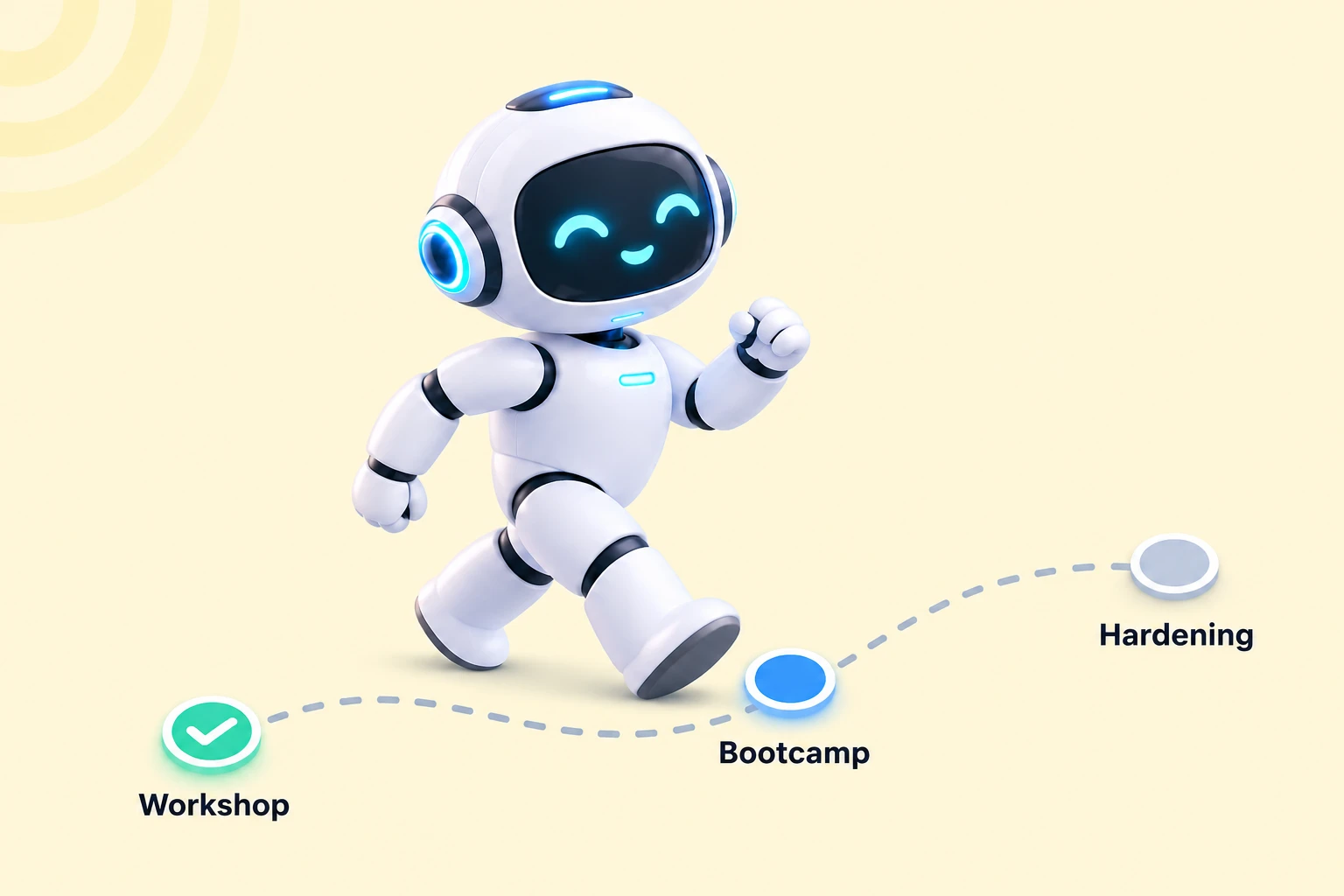
A workshop is a starting point. Teams that want support while the material turns into daily practice move into the Reliability Bootcamp, with office hours while they build.
If, partway through, you'd rather have the work done alongside your team than learn it first, that is what our Production Hardening engagement and our forward deployed engineers are for. If you're not sure where your system stands, a Reliability Audit maps it first. All of it follows the same method, our Production Protocol.
We don't teach a curriculum we haven't used ourselves. These numbers come from Crawlify, the data-extraction system we built, broke on purpose, and hardened with the same three patterns.

60 of 62
workflows recovered on their own after we forced them to fail

1,600+
eval tests run against hand-verified gold datasets

$0.0041
to re-run 14 of 41 nodes in a targeted repair, instead of the whole job
Cohorts are priced by team size and format. Tell us your team and goals and we'll put together a proposal. A half-day executive briefing and a multi-week bootcamp take very different amounts of preparation and time, so there's no single published price.
AI training for employees should match the audience. Leaders need a short briefing on what AI can safely do, what it costs and where it fails. Engineers need hands-on practice with what breaks in production: durable execution, evals that gate deploys, and approval gates on risky actions. Generic prompt courses teach neither. Our three programs follow that split: a half-day Executive AI Briefing, a one-to-two day Production AI Workshop for engineers, and a multi-week AI Reliability Bootcamp with office-hours follow-up.
Three patterns. Durable execution: how to make a long-running agent job survive a crash and resume at the step that failed. Eval-gated deployment: how to build a test suite from your system's real failure cases and block any deploy, including a model update, until it passes. Approval-gate architecture: how to make anything an agent does that can't be undone wait for a person to approve it, with a circuit breaker for repeated failures. It is hands-on, and wherever the format allows we teach against your own codebase, so every exercise maps to a system your team will keep running.
No. Prompt-engineering training teaches you to get better output from a model. The Production AI Workshop teaches what happens around the model once it is in production: what stops an agent from losing its work in a crash, from shipping with drift nobody detected after a model update, or from taking an irreversible action nobody approved. It is taught by engineers who build production agents for clients and run their own, so the examples come from systems that have actually failed and been fixed.
Both, in different formats. The Executive AI Briefing is a half-day, non-technical session for leadership on what reliable AI actually requires and what to ask a vendor before signing. The Production AI Workshop and the AI Reliability Bootcamp are hands-on and built for the engineers who will write and maintain the code. You can also book the briefing first, so leadership and engineering share the same vocabulary, and then send the engineering team to the workshop. Each program is scoped separately, so you only book the ones that fit.
Your own codebase, wherever the format allows. It is the fastest way to make the training stick, because the failure cases the team studies are the ones their own system will hit. Before a hands-on session we agree what access we need and which parts of the system we'll work on. The half-day executive briefing is the exception: it isn't a coding session, so it uses general examples, drawn from real production failures, to explain what goes wrong and why.
It depends on the program. The Executive AI Briefing is a half day. The Production AI Workshop runs one to two days, depending on how much of your own codebase we work through. The AI Reliability Bootcamp runs for several weeks alongside your team's real work, with office-hours access throughout. For an engineering team, the workshop is the natural place to start: it is complete on its own, and the bootcamp can follow if the team wants support while it builds.
Yes. The Production AI Workshop is a complete engagement on its own, and there is no expectation that it leads anywhere. If the team wants support while its lessons turn into everyday practice, the AI Reliability Bootcamp picks up from there, with office-hours access and reviews of the team's real changes as they ship. And if, partway through, you'd rather have the work done alongside your team than learn it first, Production Hardening or a forward deployed engineer is the next step, and the workshop material carries straight over.
Because AI consulting is usually sold on speed: how fast a team can ship something. Reliability training is about what happens after the demo, when the agent meets real traffic, a model update, or an action that can't be undone. It is less exciting to sell, so it tends to appear as a line in a case study. We built it as a first-class service because that gap is exactly what the rest of our work exists to close, and what we practise on Crawlify, the system we run ourselves.
Tell us your team size and what you're building. We'll suggest the program that fits and put together a proposal.
Who would attend, what they're building, and whether you want a briefing for leadership, a hands-on workshop, or ongoing support. We'll come back with a program and a proposal.